What Are the Three Goals of Cybersecurity? The CIA Triad Explained (2026)
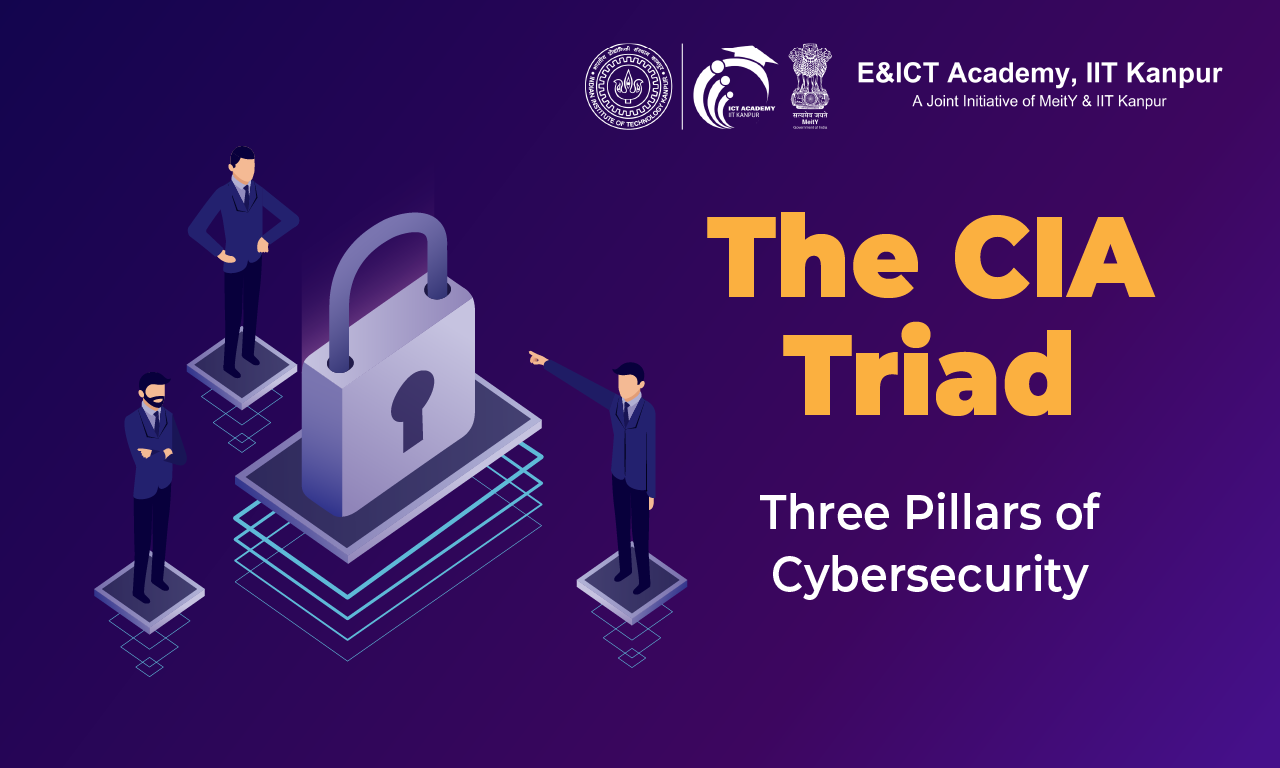
The three goals of cybersecurity are confidentiality, integrity, and availability, known together as the CIA triad. Confidentiality keeps data private. Integrity keeps it accurate. Availability keeps it accessible to the right people. Almost every security tool, policy, and control an organisation uses maps back to one of these three goals, which is exactly what makes the model so useful.
According to IBM's Cost of a Data Breach Report, the average cost of a data breach reached $4.88 million in 2024, with failures in access control, data accuracy, and system uptime among the most common root causes. Each of these maps directly to one of the three CIA triad goals. Understanding what these goals actually mean, how they interact, and where they fall short is the starting point for understanding how security teams think and why they make the decisions they do.
Best Gen AI in Cyber Security Course: Enroll Now!
Understanding Cybersecurity: A Quick Primer
Cybersecurity is the practice of protecting networks, devices, applications, and data against unauthorised access, use, disclosure, disruption, alteration, or destruction. As more of banking, healthcare, education, and manufacturing moves online, the attack surface keeps growing and attackers have more ways in than ever. If any of these terms are new to you, our broader introduction to cybersecurity threats, risks and best practices is a good place to start before this deeper dive into the CIA triad.
That is why serious security is built around a small set of clear objectives rather than an endless list of tools. The best-known set of objectives is the CIA triad, and it has guided information security policy for decades. It appears in the core standards of the field, including the NIST Cybersecurity Framework (CSF 2.0), ISO/IEC 27001, and India's IT Act compliance frameworks. Our guide to cybersecurity frameworks: NIST, CIS and other standards breaks down exactly how these standards operationalise the triad in practice.
What Are the Three Goals of Cybersecurity?
The CIA triad captures, in three words, what it actually means for a system to be secure.
A useful way to see it is to think about how a system can be broken. Unauthorised access breaks confidentiality. Tampered data breaks integrity. A service that goes dark breaks availability. Every real-world incident is some version of one of these three, and every control a team puts in place, including firewalls, encryption, access management, and backups, exists to protect one or more of them.
Consider a single online banking application. It needs confidentiality so no one else can see your balance. It needs integrity so a transfer of Rs. 500 cannot silently become Rs. 50,000. And it needs availability so you can actually log in on the day your salary arrives. Weaken any one of the three and the whole service stops being trustworthy.
1. Confidentiality: Keeping Information Private
Confidentiality means sensitive information is available only to the people authorised to see it. This is the goal most people picture when they hear the word cybersecurity, because it maps directly to the headlines: data breaches, stolen credentials, and unauthorised surveillance.
Plain-language test: Are only the right people able to see this information?
Teams protect confidentiality in layers. Common controls include:
- Data encryption at rest (protecting stored data) and in transit (protecting data moving across networks)
- Role-based access control paired with multi-factor authentication
- Network segmentation to isolate sensitive systems from general traffic
- Data classification policies that identify what needs the strongest protection and what can be shared more freely
Also read: Cybersecurity in the AI Era: Is Your Business Ready for AI-Powered Threats?
Confidentiality tends to fail in one of three ways. An outside attacker breaks through perimeter defences. An insider with legitimate access abuses it intentionally or carelessly. Or someone makes a simple mistake, like emailing a spreadsheet to the wrong address. This is why penetration testing matters so much: by replicating what a real attacker would do, security teams find the gaps in confidentiality before anyone malicious does.
In the Indian context: India's Digital Personal Data Protection Act 2023 (DPDP Act) places specific legal obligations on organisations handling personal data of Indian citizens. A breach of confidentiality is no longer only a reputational risk in India. It is a potential regulatory penalty.
2. Integrity: Ensuring Data Is Accurate and Unaltered
Integrity is about the accuracy, consistency, and trustworthiness of data across its entire life cycle. Keeping information private is not enough on its own. Organisations also need to be certain the data has not been changed, whether by a malicious actor, a faulty system, or an unauthorised edit.
Plain-language test: Can you trust this information to be correct and unchanged?
Typical integrity controls include:
- Cryptographic hash functions and checksums that produce a unique fingerprint for a dataset, making any alteration immediately detectable. As encryption standards evolve, it's worth understanding what post-quantum cryptography means for the long-term reliability of these hash functions.
- Version control and immutable audit logs that record who changed what and when
- Digital signatures that verify both the authenticity and integrity of documents and communications
- Strict change-management processes for critical systems that require multiple approvals before any modification goes live
Integrity failures are particularly dangerous because they can go unnoticed for a long time. A financial record quietly altered, or a software update tampered with before release, can cause harm long before anyone realises something is wrong. The NotPetya attack of 2017 is a documented example: malware spread by corrupting legitimate system updates, destroying data rather than stealing it. In 2026, AI tools are beginning to help detect subtle data anomalies faster than manual review ever could, flagging changes that no human reviewer would catch in a large dataset.
Also Read: Why Generative AI Is the Future of Cyber Threat Detection
3. Availability: Keeping Systems and Data Accessible
Even perfectly private and perfectly accurate data is useless if you cannot reach it when you need it. Availability is the goal of keeping systems and information accessible to authorised users whenever they need them.
Plain-language test: Can the people who are supposed to have access actually get to the information and systems they need right now?
The threats here look different from the other two. Distributed denial-of-service attacks overwhelm systems with traffic until they stop responding. Ransomware locks organisations out of their own data — our deep dive into ransomware, malware and social engineering attack types covers exactly how these availability-breaking attacks work and spread. Hardware failures, power outages, and natural disasters take systems offline regardless of attacker intent. Teams defend availability with:
- Redundant infrastructure and automatic failover so a single hardware failure does not cause a complete outage
- Frequent backups stored separately from the primary environment, with tested recovery procedures
- Load balancing and traffic monitoring to distribute demand and absorb spikes
- Cloud-based resilience strategies that spread workloads across multiple geographic regions
Availability has grown significantly more complex as workloads spread across hybrid and multi-cloud environments. A single misconfiguration in a cloud environment can trigger a major outage, and the speed at which AI-assisted attacks can identify and exploit availability weaknesses is increasing. Our guide on cloud security risks, models and best practices covers this shift in more depth. The 2024 CrowdStrike incident, where a faulty software update caused widespread outages globally including across Indian enterprises, is a reminder that availability failures do not always require an attacker.
How the Three Goals Work Together and Against Each Other
The three goals are not a menu. They work as a set, and they frequently pull against each other. This tension is one of the most important things to understand about real-world security.
Lock data down tightly enough for perfect confidentiality and it becomes slow and difficult to access, hurting availability. Make a system effortlessly available to everyone and you put confidentiality at risk. Add extensive integrity checks to every transaction and you may introduce latency that reduces availability. Good security is the discipline of balancing all three for a given system, not maximising any one of them.
That balance shifts with context. A public-facing marketing website leans heavily toward availability, since the content is meant to be seen and downtime is the main concern. A hospital patient records system leans toward confidentiality and integrity, because a leaked or altered record can directly harm a real person. A financial trading platform must prioritise all three simultaneously: a breach, an altered trade record, or a one-minute outage during a market event each has catastrophic consequences.
The three questions the CIA triad asks remain the right ones for any security decision: who can see this, has it been tampered with, and can authorised users access it? Deciding which goal matters most for each specific system is one of the first things a security team does when designing protection for anything.
Extensions to the CIA Triad
The CIA triad is a foundation, not the complete building. Critics point out correctly that three goals cannot capture everything modern security has to worry about. The model says little about authentication (proving you are who you claim to be), non-repudiation (ensuring an action cannot later be denied), or accountability (tracing an action back to a specific person). Because of this, practitioners often extend it.
The DAD Triad names the failures that the CIA triad tries to prevent: disclosure (the failure of confidentiality), alteration (the failure of integrity), and destruction or denial (the failure of availability). Thinking in terms of the DAD triad is useful for security teams who want to reason like an attacker rather than a defender.
The Parkerian Hexad expands the CIA model to six elements, adding:
- Possession or control: ensuring the physical or digital possession of data has not been transferred without authorisation, even if the data itself was not accessed
- Authenticity: verifying that information genuinely is what it claims to be and comes from who it claims to come from
- Utility: ensuring that data remains in a usable and meaningful form, not just technically accessible
None of these models replaces the CIA triad. They build on it, refine it for specific contexts, and address gaps that become visible as threats evolve. The fact that newer models extend rather than discard the CIA triad is a strong signal that its core logic remains sound.
Why the CIA Triad Still Matters in 2026
Some argue the three goals are too simple for a threat landscape that includes AI-powered attacks, supply chain compromises, insecure IoT devices, and autonomous agent systems. In practice, though, nearly every modern control is still understood through confidentiality, integrity, and availability.
Newer approaches such as Zero Trust architecture and cloud-native application protection platforms are not alternatives to the CIA triad. They are ways of strengthening one or more of its pillars. Zero Trust strengthens confidentiality by eliminating the assumption that anyone inside the network can be trusted. CNAPP platforms strengthen availability and confidentiality by continuously monitoring cloud environments for configuration drift and exposure. Both are CIA triad implementations, not replacements.
AI fits the same pattern. AI-driven security tools now reinforce all three goals simultaneously: detecting threats to confidentiality faster, flagging integrity anomalies in data that no human reviewer would catch at scale, and predicting and absorbing attacks that would otherwise compromise availability. Our guide on AI in cybersecurity: how artificial intelligence is transforming cyber defence covers this shift channel by channel. The tools are new. The objectives they serve are not.
How Organisations Put the CIA Triad Into Practice
Putting the triad to work starts with knowing what you are protecting. Security teams first identify their assets and decide which goal matters most for each one. Then they layer on appropriate technical controls, employee training, and incident response planning, and revisit the mix as systems and threats change.
The practical sequence typically looks like this. Identify all assets: data, systems, applications, and infrastructure. Classify them by sensitivity and criticality. Map each asset to its primary CIA priority: what would cause the most damage, a breach of privacy, a corruption of data, or a loss of access? Apply controls appropriate to that priority. Test those controls regularly through penetration testing, vulnerability scanning, and red team exercises. Review and update as new threats emerge.
For Indian organisations specifically, the CERT-In (Computer Emergency Response Team India) guidelines and the DPDP Act 2023 create specific obligations that map directly to the CIA triad. Data fiduciaries under DPDP must implement technical and organisational measures to ensure confidentiality and integrity of personal data, and must notify CERT-In within six hours of a significant incident, which makes incident response and disaster recovery planning as much a compliance requirement as a security one. Our broader guide on cybersecurity compliance and regulatory requirements covers how these obligations extend beyond CERT-In to other frameworks Indian organisations must meet.
Frequently Asked Questions
What are the three goals of cybersecurity?
The three goals of cybersecurity are confidentiality, integrity, and availability, known collectively as the CIA triad. Confidentiality ensures only authorised people can access specific data. Integrity ensures data remains accurate and unaltered without authorisation. Availability ensures systems and data are accessible to authorised users when they need them. Every security control an organisation deploys maps back to one or more of these three goals.
Why is the CIA triad important in cybersecurity?
The CIA triad gives security teams a stable, shared language for evaluating and designing security controls. Rather than chasing individual threats, teams can ask three fundamental questions about any system: who should be able to see this, should this be modifiable, and does it need to be accessible at all times? These questions guide decisions about encryption, access management, backup strategies, and incident response planning across every type of organisation.
What happens if one part of the CIA triad is compromised?
The three goals are interdependent, so a failure in one frequently leads to failures in the others. A data breach (failure of confidentiality) can expose information that enables an attacker to alter records (failure of integrity). Ransomware locks organisations out of their own systems (failure of availability) while also threatening to publish stolen data (failure of confidentiality). A supply chain attack that tampers with software before distribution fails integrity first and then potentially compromises confidentiality and availability across every organisation that installs the tampered update.
How is availability different from confidentiality and integrity?
Confidentiality and integrity are about protecting data from those who should not see or change it. Availability is about making sure the people who should have access actually can, whenever they need it. The threats are different too: confidentiality and integrity are typically threatened by attackers trying to get in or change things, while availability is threatened by those trying to shut systems down, as well as by hardware failures, natural disasters, and misconfigurations.
What is the DAD triad and how does it relate to the CIA triad?
The DAD triad (disclosure, alteration, and destruction or denial) names the three ways the CIA triad can fail: disclosure is the failure of confidentiality, alteration is the failure of integrity, and destruction or denial is the failure of availability. Where the CIA triad describes what security is trying to achieve, the DAD triad describes what attackers are trying to cause. Security teams find the DAD framing useful for threat modelling because it encourages thinking from an attacker's perspective rather than a defender's.
Is the CIA triad still relevant to modern threats like AI-driven attacks?
Yes. Modern approaches including Zero Trust architecture, cloud-native security, and AI-driven threat detection are all implementations of CIA triad principles, not replacements for them. Zero Trust strengthens confidentiality. AI-powered anomaly detection strengthens integrity. Redundant cloud infrastructure strengthens availability. The threats have evolved significantly in 2026, but the three questions the CIA triad asks remain the right foundation for any security decision.